 If A is for armagnac, then in my Gascon alphabet, B must be for Boudin. Maybe it’s just that I am on just one cup of café au lait on a too early Sunday but it’s the word that springs to mind. Cold winter morning= Cold enough for killing Pigs= Porc, le prince de l’hiver- means it’s time to make Charcuterie = Charcuterie uses all the morsels of meat and in the scheme of things when the carcass hangs from my neighbor’s barn rafters, we first make the Boudin. So, B is for Boudin.
The first time I assisted (with my camera only) at the Sabadini’s farm was a January morning nearly 10 years ago. I was too busy capturing the antique scenes on my brand new Nikon: heads bent over a steaming bath as many hands scraped off the hair; Denis’ sure hands as he gutted the hog; the freshly laundered white linen cloths that wrapped the carcass like a shroud; the well-used tools for making charcuterie on the farm laid out on the old farm table; grand-mère Yvette carrying the blue plastic basin of bright red blood to the makeshift butcher shop in the garage. The next year, I brought my camera again and my apron.
The first day of the Fête de St. Porc is a celebration of hard and careful work. The Sabadini’s like many small food producers here in Gascony, raise a cash crop, in this case the Blondes of Aquitaine beef cattle. But all the rest of the hard work on the farm revolves around the food they will eat and share with their lucky neighbors—from fresh eggs to grapes for wine to the annual pork production of hams, saucissons and pâtés.
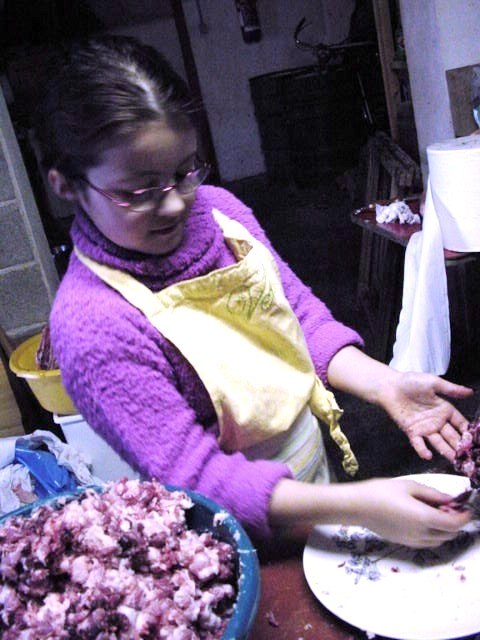
My particular favorite, as much for the process as for the delicious results, is the making of the boudin. Let’s be frank, this is black pudding or blood sausage and it is indeed made from the blood of a freshly slaughtered pig. Denis plunges his hand in the warm slippery liquid and stirs vigorously gathering the small threads of fiber in his hands, a spongy mass. His maman, Yvette then whisks this basin of blood to the garage and keeps it warm while she begins the bouillon in which the meat will cook. By the time she has scraped the carrots, chopped the leeks, quartered the onions, salted, pepper and added her ‘secret’ spices, her son, husband and the uncles arrive with the pig’s head. Once chopped into pieces, the ears, meaty cheeks, jowls and couenne or skin is added to the pot. The brain is reserved for frying. This giant marmite steams away on a gas tripod by itself helping to warm the meat atelier as sausage cases are rinsed in vinegar and laid out for filling.
Once the meat is cooked to falling off the bone, the pieces are ladled out, cooled and chopped roughly with giant cleavers- meat, skin, and cartilage. At this house, just enough blood is added to bind the meat mixture before seasoning well with salt, pepper and nutmeg. Other friends add whole leeks and onions ground in the sausage grinder and four times as much black pepper. Each family has a master taster and here it is an aunty who arrives to taste the soupy mixture for enough salt.
Once consecrated by this expert palate, the sausage casings are carefully filled, tied and placed in an old gauze sack once used to cure a ham. Yvette adds a jug of cold water to break the boil in the now simmering bouillon that continues cooking over a wood fire in the tiny cheminée in the back room. Using a willow branch to hold the sack, she gently plunges it, two or three times in the hot broth before lowering it to simmer for an hour or so.
An hour or so is just enough time for us to take a break and head for the farm kitchen where Brigitte has laid the table for a casse-croute of saucissons, cornichons, black radish, baguettes, and some fried rounds of boudin from a neighbor’s pig. Boudin is the gift that you bring round during this time of year. There is enough to share. Boudin is the beginning of a year of eating high off the hog. Boudin is a love song to tradition. In Gascony, it’s safe to say B is for…Boudin.






 Posts
Posts