A la Sainte Catherine... ...tous bois prend racine.

‘Le Petit Bleu’, the local paper in my corner of Southwest France- has a dicton or proverb on the corner of the weather page for everyday of the year—so many saints, so many sayings.
“Si Saint-Lambert est pluvieux, suivent neuf jours dangereux”- if it rains on April 14- St.Lambert’s day, nine ‘dangerous’ days days follow.
Or this one for the 5th of August— À Saint-Abel, Faites vos confitures de mirabelles- On Saint Abel’s make your plum jam! Like gentle reminders that there is a time and rhythm in country life, they count off the year and seasons as I live in Gascony.
When I asked when to plant my hazelnut and wild plum hedgerow, my friendly Gascon neighbors all responded the same… “A la Sainte Catherine, tous bois prend racine”- “On Saint Catherine’s day, all wood takes root.” Little did I know that this simple country proverb I mentioned to Sarah at Saveur.com would become a major force on my Gascon calender... with a little help from a Long Village* neighbor just 5 miles down the canal. Not only am I a 'Catherine', but my birthday falls 4 days later, so what better way to spoil myself doubly than to choose a green present and add to my own orchard here at the Relais de Camont.
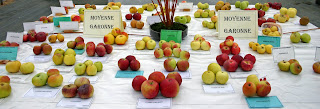

So what do a third-century virgin martyr and 2,000 heritage fruit trees have in common? The answer is a 25-acre site nestled in the rich alluvial valley of the Garonne River at Montesquieu in the Lot-et-Garonne department of Southwest France. Here, I was lucky enough to meet and talk to the passionate power behind this far reaching program to “research, protect and honor” the fruitful heritage of native species of Southwest France. And we are invited for a sneak preview by Evelyne Leterme, director and passionate founder of the CVRA- Conservatoire Vegetal Regional d’Aquitaine .
So take a mini-French vacation this weekend with me in Gascony and discover the French passion for a bite of old fashioned fruit. This year, on Ste. Catherine’s feast day weekend, November 24 & 25, the Regional Plant Conservatory of Aquitaine, locally called Le Verger-Museé , is hosting their annual Fete des Arbres.


Not long ago Mme. Leterme walked me around her fruit fief on an oriental carpet of leaf and fruit. Apples weighed heavily on sculptured boughs; semi-dwarf trees looked like some mad bonsai artist had been let loose in the orchard. There was a lone late peach variety that yield an neon peach globe, a Pêche Dur, that had great texture, like a mango and tasted of fall rather than summer- rounder, less acidic, honey juiced and …ultra-peachy. Several dozen fig varieties invited plucking; the most humble deep purple pouch, a Ronde de Bordeaux- not even as big as an egg, popped into my mouth and exploded with sweet nectar and crackling seeds. At Evelyne’s invitation, I filled my pockets with white-dotted Court Pendu Rouge de Lot-et-Garonne, a true native variety and one of the first trees I planted in my own orchard for the French Kitchen.
In the blossom spring and fruitful summer months the Orchard Museum is a delight to visit to discover the old and more aesthetic methods of planting trees and vines together. Alternating rows of trees with crops like wheat or corn are called joalle; hedgerows of hazelnuts, plums, and figs create an enclos, or enclosure, around a small pasture; strips of land are planted with riotous pink cosmos and orange zinnias to let the soil rest and feed the hardworking bee and butterfly population.


Mme. Leterme tells me how she came here from the Ecomusée de la Lande having collected samplings of fruit trees as she bicycled through the Basque country protecting both genetic history and the stories of those who labored the earth. In 1996, when she arrived in the Lot-et-Garonne, it was to establish what would become the most important collection of apple trees in France. She would begin to catalogue, protect and develop more than 800 ! varieties of apples and over 1000 other varieties of sixteen other species here in quiet Montesquieu.
Mme. Leterme’s quiet passion is catching. I found myself getting excited about the 22 different hazelnut varieties, a singular collection that she saved from destruction in Bordeaux. My own 24 tree orchard started to grow like a benevolent monster in my head as I imagined the tartes au pommes fines that I would make with a Pomme d’Anis Rosalie, an anise-scented apple or the striped Rose de Virginia or summer apple. What had once been an overgrown commercial apple orchard at Camont could live again in a tribute to the tastes and flavors from another time, when an apple or a peach, burst with its own identity of place and name.
Overwhelmed with choice, what would I chose for my birthday present? Symbolic and delicious, yet beautiful and productive? Et voila! As we reached the back of the 25 acre site, I spotted the perfect gift tree, bearing leathery orbs to sport like Christmas ornaments in the orchard.
And hidden within? Enough jewels to tempt a pirate queen. Arrrr mateys, there’s treasure within!

Apples and Saints are in the air in New York too; just ask Harold McGee at the NYTimes. Stay tuned to see what happens to this tranquil setting with 5000 hungry Frenchmen arrive. Oh, there'll be a recipe or two of course!
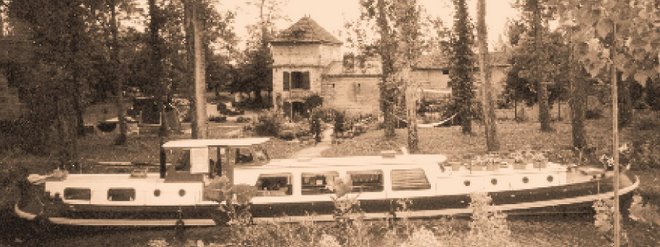
*"the Long Village"...what I call the 500 miles of canals and river that thread across France!




 Posts
Posts