Showing posts with label cassoulet. Show all posts

January 19, 2009

Cassoulet- Kate's Basix French Kitchen Recipe


Cassoulet Recipe


Developed at "Camp Cassoulet"-- a Kate Hill French Kitchen Adventure.

This is the basic, bonafide, easy to prepare, authentic, traditional, real, regional version of cassoulet that I prepare, teach, cook and eat in my French Kitchen. The emphasize is on careful combining of very good ingredients, slow cooking and hearty enjoyment. I use duck confit and sausage de Toulouse, ventrèche ( salt cured pork belly), and pork rind for the meats. This is not gosple but pretty close. As much a state of mind as a recipe, this Cassoulet should feed your spirit as well as your belly. Invite a few friends- make it a party. That's what Camp Cassoulet is about.

This makes a large cassoulet that fills a 4-liter cassole and feeds 8 people easily.

Step 1: the beans

Ingredients:

  • beans -1 kg dried beans (tarbais, coco, lingots, or other plump thin skinned white bean (for dried beans- soak several hours, over night or cover with water, bring to boil and let sit one hour.)
  • 1 onion- peeled
  • one whole carrot
  • 2 cloves
  • 2 garlic cloves
  • Thick slice of ventrèche (pancetta), salt pork, bacon or ham ends.
  • Ham bone or hock
  • Fresh pork rind-(couenne) about a 4-by-12 inch strip or about 100gr, rolled and tied with a string
  • Bouquet garni- bay, thyme and parsley stems.
  • black peppercorns- a dozen slighty crushed

Place all of the above ingredients in a large pot, cover with 2 litres of water; because of the addition of the ham bone there is no need to season with salt at this stage. The seasoning can be adjusted when the cassoulet is put together.
Bring the bouillon to a boil then turn down to simmer and let cook gently for 1 hour or until beans are just barely tender. How do you tell if the beans are done? The skins go papery and begin to collapse and the cooking liquid is milky.

Step 2: the meat- prepare while the beans are cooking.

Ingredients: This is where you can be flexible using fresh sausage, preserved duck or goose, ham or cured pork, lamb shanks, etc. We used:

  • Duck- confit de canard- one/half leg per person (note: after slipping off most of the softened congealed fat from the surface of the duck legs, we trimmed any excess skin so as to leave just a covering to protect the meat. We jointed the thigh from the drumstick and then teased the thigh bone out resulting in a neat little package of confit meat that is easier to cut in the plate.)
  • Saucisse de Toulouse- about 500 grams or about 15 cm/6 inches per person. This is a fresh pork sausage made from primarily the shoulder meat and seasoned with salt and pepper. Nothing else.
  • Saucisse de Couenne- I love how these succulent sausages made with lean pork meat and the soft rind taste. They sort of explode with flavour in the cassoulet.
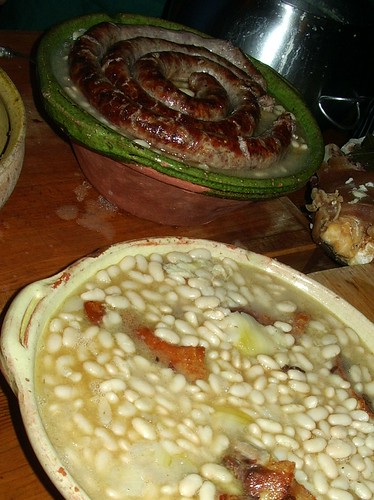
Brown all of the above; the duck confit in a sauté pan and the sausages we cooked over the grill, however, they could have been pan browned as well. You want a nice hot fire to brown the skins and it’s preferable to not cook the sausages 100% at this stage as they will continue to cook in the cassoulet and give their juices to the broth. Note: Because we buy the sausage in one long link we made a pretty spiral that may be browned as a whole on one side then turned over in one piece to cook the other side. We did this on a grill over the hot ashes of the log fire.

Step 3: to assemble the cassoulet

The traditional cassole bottom is just half of the diameter as the top, making a deep slant-sided glazed terracotta pot (see pictures). Remove the bouquet garni, ham bones, onion, carrot and rind from the beans. I chop the onion, carrot and rind into small bean-size pieces and take the tender meat off the ham bone then return all to the beans and gently stir in. USing a slotted spoon, the cassole is then layered with the beans, the confit and pieces of toulouse and rind sausage then finished with a layer of beans. Adjust the seasoning of the broth from the beans; a little salt, some more black pepper and pinch of piment d’esplette. the tweaked bouillon/bean stock is wonderfully savoury. Now add this liquid to the cassoles until the beans are just covered. Any remaining bouillon should be saved for basting if needed or making bean soup with leftovers.

Step 4- To cook the cassoulet

Slip the cassole into a very hot oven (around 450’ F/ 275’C); turn down the oven after 30 minutes to medium heat- 350' F/175'C and then let the cassoulet bake slowly as long as you can. The cassoulet in the electric oven is nicely browned in about 1-1/2 to 2 hours; ‘break’ the crust by pushing into down into the juices two or three more times. A wonderful crust forms during cooking so there is no need for a sprinkle of breadcrumbs* as the beans and starchy sauce do this by themselves. Cassoulets are not fatty and are nicely done in about 2 hours. If you start preparing the cassoulet at around 3 pm and you'll be sitting at the table by eight pm. This could be done in advance- all or in part by cooking the beans, and or assembling before baking.

Step 5: to serve

Pour a glass of hearty red wine like a Madiran, Cahors or Zinfandel, break the crust on top at the table, ladle the steaming cassoulet into dishes and prepare to be very full and very warm as stories are told around the kitchen table well into the night!

January 16, 2009

To my Cassole waiters... a French moment.


Some days.
As I've written recently, French days in France are usually full. Varied. Rich. Full.
These are days when time moves to it's own clock, counting events and moments rather than minutes and hours. Time to stir the pot and cook slowly.

Tic, tic- 20 minutes to gather dried twigs for kindling.
Tic, toc- 30 minutes to drive across the frosty countryside to pick up more beans.
Tic, toc, tic- an hour goes by standing in line waiting for the phone shop to wait on me.
Ding, ding, dong, screammmmmmmmm. the village bells and siren announce lunchtime and EVERYONE must stop for 2 hours and close their doors- post office, banks, grocery stores. Oh, forgot? get back in your car and drive home to wait until after the 2 o'clock return rush hour to reopen!!!!
tic, tic, tic...clip, clip- the quiet time passing as 2 acres of fruit trees and roses get clipped one by one during a quiet 2 hour lunch of winter gardening.

See, that's how France works for me; harmonious units of time interrupted by screaming fits of being out of sync. Mostly it is the harmony and rhythm of these days that I so love. It takes an hour to prune an old crab apple tree. Another for the fig. Who cares? There is time enough in every season. right?

But what happens when culture clashes and the sound of a micro-digital chronometer meets the steel village church bells. It's like that old kids' game- rock, paper, scissors. The steel bells wins- every time. I call these the French Moments, the head shaking 'I don't get it' moments, when my American self gets taken off at the knees.

All this to try to explain why those wonderful Not Brother cassoulet pots that were mailed out before Christmas still haven't arrived? My local French La Poste Mistress assures me, "Madame, 12-15 days delivery time means 12-15 working days; no saturdays, no sundays and, mon Dieu, all those holidays, too. It was mailed economique, oui? (I can hear the Gallic shrug!) So this package you mailed to the Etats Unis December 19? Then it is only 4 days late. It's a long way. Don't worry!"

She smiled and I said, "Merci et au revoir, Madame". So please, in the ticking minutes of late deliveries and anxious mistrust of all involved, take a deep breath, think how many long weeks it took to throw, dry, glaze and fire the cassole pot, and think about who you will invite to help you make and eat that great cassoulet. When the cassole arrives. In a Long French Moment, thanks.

And to keep your cassoulet appetites whet and inspired, see what Riana is doing in her Slow Kitchen here at Garlic Breath!

November 22, 2008

Pork & Beans- a very faux cassoulet


When the Diva, Judy Witts asked me 'what are you making for supper?' I was almost embarrassed to say not Cassoulet. And when she suggested that we post a 'come one, come all' let's cook together on our ongoing, occasional Whole Hog blog, I realized that a simple 'you too can do this tonight' version of French Pork & Beans was the answer.

When not cooking a full-blown Camp Cassoulet version (see the official recipe here!), I sometimes just wet the beans, add anything vegetable lying around and toss in some artisanal bacon at the end. Eh Voila! my version of pork and beans. Next, toss some leftover cheese in a pan with a slice of baguette on top and this is a simple supper that stands up to a bottle of new wine, Beaujolais or otherwise.

My non-recipe recipe goes like this:

Take 500 grams or about 1 lb of dried beans ( I used the fat pillowy Coco beans we grow here in Southwest France), put them in a pot of water to soak during the day.

Drain the now plump beans and put them in a pot. Cover with just enough water, about 3-5 cm or 1 1/2 - 2 inches. Put over a medium hot burner.

Add a couple of carrots, an onion, a few shallots, and two cloves of garlic chopped in small bean-sized pieces. Add a bay leaf, some fresh or dried thyme, a few black pepper corns and some lovage or celery leaf. Cover, let come to a boil, then turn down and simmer for about 45-50 minutes or until the beans are tender. Taste and salt as desired.

While the beans are getting done, fry up some good thick pieces of bacon, a hunk of ventreche, salt pork, ham or a couple of sausages. That's the Pork part. Then toss the meat and any fat into the Beans, stir and serve.

Too simple, too delicious. And it takes about 5 real minutes of chopping, and 45 minutes of cooking. That's less than an hour; less than the time it takes to run out to the store or order mediocre takeout. While the beans are cooking you can read a book, take a walk, or just watch the leaves drop from the trees. And you don't even need a can opener.

As I said, it's not cassoulet, but it is very tasty. And the next day there are leftovers for lunch with an egg dropped in the pan to poach in the bean liquor.

Buy good beans, use good water, kiss your butcher, pay attention. That's what makes the difference!This is Simple French Food.

beans at the Santiago de Compostela market

November 19, 2008

Season Changes- weekend cooking breaks from Cassoulet to Confit de Canard


Gotta love the l'ete Indienne we've been having this year. If there could be a more perfect fall, it would have to be like this one in a favorite painting of Monet's little studio boat that he rowed along the Seine and her tributaries.


Here along the Canal de Garonne, my own canal has been aglow with turning leaves that rolled from acid green to yellow, from gold to deep ochre with a splash of plum and bright red thrown in for fun.


It's just as well the weather held, as this was the time to do a bit of boat repairs.
Taking advantage of the bluer skies and still warm nights, Mark Wiggs, master marine carpenter and boatwright from Angleterre, has been sorting out 50 years of failing plywood and rusty screws.


As you can see, what that really meant is that Mighty Mark took the entire wheelhouse down with his trusty hammer and saw! Now he is building, from the steel frame up, a brand spanking new traditional solid red cedar and glass room perfect for winter morning cafe-au-lait and late summer evening suppers.


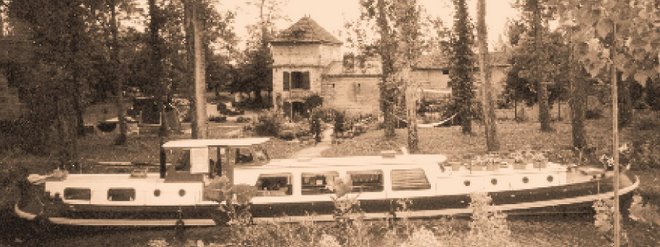
Here are a few pix for posterity and just to prove how mad I truly am. Twenty-two years of the Julia Hoyt and we're both ready for a facelift!


Stay tuned for the final unveiling soon!

Along with these structural changes, the season has changed, too, from the gastronomic overload of Fall's abundant markets and menus to the quieter space between the plates, the mid-week pause and to the gracious unhurried weekends.


To celebrate Winter's tardy arrival, I am offering a handful of weekend retreats, culinary quiet time and just enough good food and market color to usher in the festive time ahead. Interested in a weekend break in the French Kitchen? Just click here at French Kitchen Adventures for more details! In the meantime, just keep drifting on the current...

November 06, 2008

Stirring the Pot at Departures Magazine- Cassoulet Cassoles


November is a funny month.
Funny Strange.
Changes seems to begin at the end of the Fall season. New Presidents for some- Nov 4, Remembrances of past peace efforts for others- Nov 11, Turkey and Thanks- Nov 27, and yet another year under the belt- Nov 29. For better or for worse, November is my month. The last couple of years I have been celebrating its gloomy and drizzling arrival with the warmest of all French regional dishes...Cassoulet.

Camp Cassoulet continues to be a popular cooking weekend program here at the French Kitchen and abroad. Lisa and Tony Geer of the Mendocino Coast's Ledford House restaurant joined Tiffany and Michael from Seattle and Olivier and Carole from NYC and Paris at the end of a wonderfully warm Indian Summer October to market and cook yet another great Cassoulet. Here, even the experts can learn a new trick or two.


My Fall season started early over 18,000 kilometers away with teaching and cooking cassoulet for over 400 people in New Zealand in August. In September, I returned home to Southwest France for another round of convivial weekends in front of the French kitchen cheminée and enough beans to flat a raft of saucisse de Toulouse and duck confit.

But the fire really started to blaze when I got the news that Departures Magazine, that arbiter of all things luxe for American Express Platinum cardholders published an article 'Cassoulet Style' by Sylvie Bigar, New York journalist and delightful culinary snoop, about cassoles and mentioned a new little scoop of my own.

It's time to reveal what's been cooking on the French Kitchen back burner. The Hill Sisters (my little sister Stephanie and I) are opening our own, on-line French Kitchen Piggery Pantry & Boutique. And guess what's in stock now?


Cassoles, cassoles and more cassoles! Authentic, traditional, purpose-built clay pots, hand thrown by the Poterie NOT Freres along the canal du Midi near Castelnaudary. In her article, Sylvie gives a good argument for a rounded bean pot, but I must agree with Jacques Pepin that the shape is not as important as what goes in it. (click here for the official Camp Cassoulet recipe and cooking trucs here!) However, as far as cassoles are concerned, what is important is the actual quality of the pot- be it clay, enamel cast iron or stainless steel.


Fortunately you can now have your beans and eat them, too. Because these clay cassoles that the Not family have been throwing for since 1830 are hand-crafted from a special mix of local clay and silica, blended and fired at high temperatures to produce a rock-hard natural terre-cuit or French stoneware. Unlike softer terracotta pots, these are meant to be baked in hot ovens for long hours; they ring like glass when tapped.


The thick glaze is a rich earth color like the well-baked crust of a cassoulet. there are glaze drips and thumbprints that speak of the atelier and roughened hands that make these sturdy bowls. Cooking only deepens the colors and ages the bowl in a duck fat sort of glow. My own cassoles are over 20 years old now and a deep dark brown.


I love these pots; and the men who make them. Like the Artisan Food School teachers we work with, Ton-Ton Robert and the next generation of potters infuse their hand-built cassoles with the sort of love and attention we use when cooking here at the French Kitchen. At the Not Potterie, the cook with clay.


Interested in owning your own authentic Poterie NOT Freres Cassole?

The price is 75 euros (approx 100 US$) plus shipping and handling and is payable with Paypal or credit card (Amex included, of course!). Just click on the "buy now' button upper right. You will be contacted about shipping options available. I drove down in the rain last week to pick up a small order ready for shipping. These pots, made by hand, one-by-one are available in very limited quantities.


The standard size is big enough to prepare a generous cassoulet for 8-10 people using one kilo of dried beans (I use 100 gr, per person) and measures approximately 30cm/12 in. x 11 cm/5 in. and weighs 2.5 kilos or 5.5 pounds.


Since the Not Pottery does not ship, I asked Robert Not to stamp these special cassoles for me so that you would know they are the real deal, straight for France and full of French Kitchen inspiration. And if that is not enough to tempt you, I'll tuck a box of the very secretive Épice Rabelais as well as the official Camp Cassoulet recipe booklet!

(NOTE: FOR THOSE ORDERING A CASSOLE AFTER 19/12/08, the special offer including free Tarbais beans is now over. The 2008 harvest is now depleted.)

To order one or more cassoles, please click on the sidebar at right or email me directly at kate (at) thefrenchkitchen (dot) com. Cassoles weigh 4 kilos packed and are shipped by the French post service, La Poste, International economique and shipping costs are approx. 35 euros depending on destination.

January 05, 2008

Ten French Recipes from Gascony you should know how to cook

Cupcakes running amuck; Mister Greenjeans back on the tube; next, we'll be eating small hamburger without buns and calling them meatballs!

As most of my friends know, I am generally unplugged here at Camont. It’s deliberate. Except for the high-speed wireless connection and my 10 million Skype-mates, I can spend all day seeing nobody at all: maybe a cyclist on the towpath; a hunter trespassing the neighbors field; the postman delivering the latest supermarket ads.

I’m not hiding out completely in a black hole and while I do read blogs and websites on a rather haphazard basis, I’d rather prune the fruit trees, re-arrange the herb garden, walk the dog. But I do read the news online, listen to NPR while making coffee and without having eaten one, I do know that cupcakes were big this year, very big. So I was delighted to see on Epicurious’ new trends for 2008 post that cupcakes will now take a back seat to frozen yogurt and that greens, mostly plants, will join the standard romaine lettuce on chain food restaurant menus. Maybe that will make Michael Pollan happy. I am all about making Michael Pollan happy because even though I don’t know the guy, I like him. I like it when he tells us to eat good, whole food that your grandmother would recognize. You see, I have been saying that to my cooking students for years...17 years exactly. And yes, that’s why I have a cooking school here, in Gascony. That’s what this food is all about here—recognizable and whole. And yes, the farmers are the new star; just ask any celebrity chef who rocks. Or see how often I write about the Butchers, Bakers, & Armagnac-makers-- or my neighbor, Denis Sabadini.

photo by tim clinch

So as I welcome you to a new year of cooking, living and writing my French Kitchen Adventures in Gascony, I wondered what I might share with you- from my kitchen to yours? What can I tell you from here that sheds a little more light on this good food, eat local, slow food movement? It amazed me how successful 'Camp Cassoulet' was (in reality as well as virtual) so I decided to come up with a New Year's list of “Ten Good Recipes from Southwest France that You Should Know How to Cook.”

Over the next few weeks, I’ll introduce you to my ‘rock star’ neighbors and explain how I came to learn these so very 'French Kitchen Basix' … and how you can cook them, too, even if you are snowed in – in Vermont at Sugar Mountain Farms. So, here's to all you new celebrity farmers and don't forget the pigs gotta still eat even if you are now going to be famous as say... Mario, or Emeril or... Yvette and Brigtte.

photo by tim clinch

My Top Ten

'French Kitchen Basix' recipes

that you should learn to cook in 2008.

  1. Cassoulet
  2. Charcuterie- learn to make something from scratch like Saucisse de Toulouse
  3. Confit de Canard
  4. Poule au Pot
  5. Garlic soup
  6. Lapin aux pruneaux
  7. a very good wine and shallot sauce
  8. perfect roast chicken in a pan- a la poêle !
  9. Navarin d’Agneau- lamb please.
  10. Pintade/ guinea hen or other game and fowl with armagnac

Since #1- le Cassoulet is here, and here and here… why don’t we start with #2- Charcuterie and clear up a few ill conceived notions about sausage. Next stop: Saucisse de Toulouse- from field to table. Here's one of your teachers- Mme. Yvette Sabadini of the Ferme Bellevue...just up the road from Camont.


December 27, 2007

Is Cassoulet Time's 'Man' of the year?


With Russia's Vladimir Putin on the cover and the year's roundup of top news photographs inside, I had to smile when I picked up the current issue of TIME magazine and found our own star French dish reaching out from The Global Advisor section. Cassoulet is indeed still in the global consciousness as a journalist from Departures magazine also called this month to ask my opinions about THE best cassoles in the world. Of course, this prompted a last minute drive down the windy road to Cassoulet country as the bidding for the Menu for Hope raffle was drawing to a close and my lovely 20-year old cassole up on the blocks.

So for those keeping track of these things, food trends and such, let it be noted that Camp Cassoulet continues in 2008 and hits the road in early spring toward the West Coast of America and then makes a special all-star French connection in New Orleans before the IACP international conference in Mid April. As IACP's country coordinator for France, I look forward to meeting other international members and sharing one of France's iconic culinary treasures in an informal and fun day at Camp Cassoulet-NOLA. More to come...


And for those wondering just what 2008 offers from my French Kitchen Adventures... stay tuned for a new look, classic recipes and way to own your own authentic cassole from French Kitchen Pantry.

December 12, 2007

Red Hot Cassoulet Bowl for $10- Menu 4 Hope


CASSOLES

A few years ago while traveling down the Canal du Midi, The Julia Hoyt and all her crew aboard were moored at a small port near Villefranche de Lauragais. This was July- Tour de France season; we popped some champagne and had foie gras baquette sandwiches as Lance Armstrong and his band of merry men whizzed by in such a fast blur they were gone before we could even register their presence. That evening we meandered over to the Hostelllerie de Etienne for the house specialty- Cassoulet Imperial and who did we see eating vast quantities of beans duck confit and sausage? Well, not Lance, but all the rest of the support members of all the racing teams stoking up on good hearty Chaurien fuel. We wandered back to the boat sated and happy to have shared in yet another victory for 'our' team- Team Cassoulet in the yellow aprons!

I share this anecdote with you, in case you haven't noticed that this is the MENU FOR HOPE week. For just one $10 (US) donation you can buy a raffle ticket to win your own hand thrown by the real deal NOT Poterie brothers Cassole. This is one of my well loved French Kitchen stables that have held dozens of cassoulets over dozens of years. I can't guarantee that you will make a better cassoulet in it, after all as Lance wrote "It's not about the Bike". However, wouldn't you ride a little harder, a little prouder if you won Lance Armstrong's winning bike for a $10 raffle ticket? Maybe your next cassoulet will look like this!


For all the information and other great prizes available worldwide, check out Pim's list at Chez Pim.com then follow these simple guidelines to win your heart's delight.

To Donate and Enter the Menu for Hope Raffle

Here's what you need to do:

1. Choose a prize or prizes of your choice from our Menu for Hope above

2. Go to the donation site at Firstgiving and make a donation.

3. Please specify which prize you'd like in the 'Personal Message' section in the donation form when confirming your donation. You must write-in how many tickets per prize, and please use the prize code. The code for my Cassoulet bowl is EU25. the Tuscan wood oven adventure is EU30.

Each $10 you donate will give you one raffle ticket toward a prize of your choice. For example, a donation of $50 can be 2 tickets for EU01 and 3 tickets for EU02 - 2xEU01, 3xEU02.

4. If your company matches your charity donation, please check the box and fill in the information so we could claim the corporate match.

5. Please check the box to allow us to see your email address so that we can contact you in case you win. Your email address will not be shared with anyone.

Any questions, just ask! and get those beans soaking! The prices will be announced on Pim's site on January 9 and the Cassoulet bowl will packed and ready to fly on Jan 10th.


Kate and her one cassoulet bowl magic oven at The French Kitchen.
See More Photos of Camp Cassoulet by Greg Orr.

For another fab prize that you can win (and Cooking with Fire photo) check out what Judy Witt and I are offering over at JUDY WITTS' Tuscan Blog.


December 10, 2007

Menu for Hope- Cassoulet Dreams

Behind the scenes of Camp Cassoulet
with Lucy Vanel, Kate Hill & David Lebovitz


When Food Bloggers get together what do they do besides the oh-so-obvious 'eat, cook & be merry' ? Let me take you behind the scenes and share this dirty little secret...

If you imagine all the hundreds & thousands of words spewing off of every food bloggers key board everyday then you can easily guess the answer.

What do Food bloggers do when they get together?
TALK.
NON-STOP TALK.
Overlapping, excitable, TALKING...with your mouth full!


Back in February when Pim and Lucy came for a long weekend of Pig Celebrations, we talked and talked and talked. Pim shared her hopes for the 2007 Menu for Hope with us. We talked over chinese dumplings; we talked over wine, we talked over truffles. Pim speaks quietly but one listens. She told me about her meetings with the World Food Program; of her desire to make the Menu for Hope donations substantial enough and focused enough. She spoke of the School Lunch programs in Africa. And as she spoke, of power coming from many, I became hopefully addicted to the idea that our food blogging words could make a difference within this virtual community.
Pim talking truffles & hope

So when I thought about what I could give to Menu for Hope to inspire YOU to give, I immediately thought of Camp Cassoulet and the great fun and good R&D (Research & Devour as fellow camper Tricia Robinson says) that we had and what makes food bloggers tick. The most photographed subject of the wonderful bean cooking weekend were the cassoles themselves. Not only did they become the star of the show, they inspired spin off posts on Epicurious.com and Saveur.com. Then Departures magazine interviewed me about a story on Cassoles. Then I decided to start exporting the heavy authentic soulful terracotta cassoulet pots to fill the demand that was writing me. Eh voila!

My Menu for Hope Raffle prize: one real authentic, well-loved cassoulet bowl from my French Kitchen and created by the Not Freres of Poterie Not.

photo of this beautiful cassole by David Lebovitz

This cassole symbolizes the power of our food blogging community coming together. This well-loved and experienced 'cacola' will be your French guardian angel perched on a kitchen shelf; a link to the French Kitchens of the past; a cradle for your culinary hopes of the future.
And just to make sure you have the spirit of Camp Cassoulet (see multiple posts in the archive here and at David L' site and Lucy Vanel's), I will include a copy of the new Camp Cassoulet Authentic Workbook & Recipe Primer.

I'll even throw in the beans! A kilo of Haricots Tarbais and the shipping by international post chez vous!

How much does this authenticity cost? This hand-thrown traditional clay cassoulet pot with which to make your Cassoulet Dreams come true? The same as it costs to help out Menu for Hope.

Just 10 bucks
6.81 euros
4.90 pounds

Not much for a chance to win this Cassoulet pot that had made hundreds of delicious cassoulets as well as help feed the dreams of dozens of school kids in Lesotho. How much does it cost to help feed some school kids? Keep them in school? Help support the local food producers that supply the school lunch food? Just a 10 dollar raffle ticket. Really want to win this bébé? Buy lots of tickets! I'll even hold your hand making your first cassoulet; you can call me on Skype and I'll walk you through the crusty bits.

So go to http://www.firstgiving.com/menuforhope4 and buy your tickets now for Code EU25.

And while you're at it, check in to see what other Euro-bloggers are offering at Fanny's site- http://www.foodbeam.com or Chez Pim of course. And look at these great pix on pim's site-


Look at these kids... Hey, I wore a school uniform just like that when I was their age! Imagine, if hundreds of food bloggers could raise $100,000 ten dollars at a time perhaps someone out there would match these donations with a nice big fat check... it's up to YOU. I know you are reading.

November 10, 2007

camp cassoulet wannabees...

photo by David Lebovitz

Interested in attending you own Camp Cassoulet?
I have posted all the details and info on my French Kitchen Adventures site- www.frenchkitchenadventures.com.

How about a Christmas Cassoulet?

i

November 07, 2007

Camp Cassoulet- post script point


Time to plant a few seeds for next year.
I stopped at the grainèterie yesterday on the way home from Bacon's birthday checkup- 46 kilos and still growing.
I bought 200 grams of petit pois and fava beans to plant in the potager now;
3 dozen crocus bulbs for the 'champs elysees' between the Relais and the Barge;
a few dozen Japanese iris to fill in the T-Jardin.

Then I spotted this one, singular goofy colored package of...you guessed it-
Haricots Tarbais.
These are the real deal straight from the Label Rouge approved Bean Co-op in Tarbes;
The variety Alaric and includes a few recipes inside as well. But not one for cassoulet.
They'll be saved until the early summer; I plant them in June, to be ready in October.
Just right for the 2008 Camp Cassoulet.

Now I am planning like crazy, a few more weekend cooking workshops- single subjects, finely focused, on site and lots of fun. Foie gras, confit, truffles, tourtiere pastries (heads up David and Lucy!), and the even more important whole hog, nose-to-tail charcuterie weekend. Check the calender for dates. All other ideas welcome.

And for the in between quiet times when Bacon and I just need a focus... this will do.


After all, what's the point, if not infinity?

November 06, 2007

Camp Cassoulet- the recipe en fin!


I never went to camp. So now and again that childhood desire arises and I create the ephemeral camp of my dreams. My ideas of it are all screwed up with Disney movies and girl scout meetings. But I’ve lived in a pup tent, can easily start a fire and make a mean s’more- (cultural translation here ) Or cassoulet.

For years, I have been referring to My Camont as Camp France, a sort of license to have fun in a somewhat unrealistic setting (silly big barge, small rowboat, princess tower house, big kitchen… in France.) As the cooking classes and gastronomic tours became the ‘day job’, Camp France needed to get a breath of fresh November air and breathe it did indeed this weekend!

Camp Cassoulet. 5 Americans, 3 British, 7 French, a pretty balanced group of cooks and not, convened over the Toussaint Nov 1st holiday here in Southwest France to put pay to all those Cassoulet making myths and most importantly, produce a serviceable boot-camp version of a ‘French Basix’ Cassoulet. for pictures see: http://www.flickr.com/groups/campcassoulet/

With a little encouragement from afar and a handful of French regional cookbooks, I set the standard under some protest from a few more vocal members of the gathering: no tomato, no breadcrumbs and no lamb (there’s nary a sheep in sight in this particular part of France.). As Kitchen Captain, I poo-poo-ed the holy trinity competition of city driven cassoulet (Castelnaudary, Toulouse and Carcassonne) in favor of a beginning place to understand that cassoulet is really… about the bean.

The resulting flavors were all I had hoped for- creamy, deep, crusty and soul satisfying. Hearty, yes, but also delicate in texture with sweet beanness and bursting with small morsels of savory salty and cured meats.

We began with three different beans- tarbais-the favorite, Roi du Macy that we found by chance at the Nerac market and similar to a Great Northern or Navy bean, and some dried Fava beans which I realized much too late came from Bolivia (oh, the carbon footprint of this peasant dish!); three different cassoulets cooked in three different ways: in the electric oven, in the kitchen fireplace against the coals, and in the small wood burning terracotta oven outside…oh, yeah and one on top of the stove- more on that later.

With 10 cooks, several bottles of wine and a dozen different pots to choose from …let’s just say it was fun, if a little chaotic. Personally, I like a little chaos in the kitchen so I felt right in my own home. With the help of a good crew of galley ghillies and able scribe Nicky noting it down, we did manage to weigh, measure, and time the official Camp Cassoulet cassoulet. Please feel free to take liberties as you must but this version should result in a very delicious, nicely crusted, deep-colored, traditional cassoulet. We ate it with a shallot vinaigrette winter salad of Batavia or escarole, a perfect bitter counterpoint to the simple sweet and salty cassoulet. For dessert David made a juicy Comice pear sorbet, splashed with a bit of Cote de Gascogne white wine served with chocolate, of course, biscotti and champagne. It was enough. Enough for a very memorable meal for 13 lucky friends in the French Kitchen of Camont.

Cassoulet Recipe

from Kate Hill’s French Kitchen Adventures- "Camp Cassoulet"

Amount: This makes a large cassoulet that fills a 4-liter cassole and feeds 8 people easily. For a visual reference for cassole look here, here, and here. And the Diva in Tuscany just sent this over in a little Tuscan homage to Cassoulet.

Step 1: the beans

Ingredients:

  • beans -1 kg dried beans (tarbais, coco, lingots, or other plump thin skinned white bean (for dried beans- soak over night or cover with water, bring to boil and let sit one hour.)
  • 1 onion- peeled
  • 2 cloves
  • 2 garlic cloves
  • Thick slice of ventrèche (pancetta), salt pork, bacon or ham ends.
  • Ham bone or hock
  • Fresh pork rind- about a 4 by 12 inch strip or about 100gr, rolled and tied with a string
  • Bouquet garni- bay, thyme and parsley stems.

Place all of the above ingredients in a large pot, cover with 2 litres of water; because of the addition of the ham bone there is no need to season with salt at this stage. The seasoning can be adjusted when the cassoulet is put together.
Bring the bouillon to a boil then turn down to simmer and let cook gently for 1 hour or until beans are just barely tender. How do you tell if the beans are done? The skins go papery and begin to collapse and the cooking liquid is milky.

Step 2: the meat- prepare while the beans are cooking.

Ingredients: This is where you can be flexible using fresh sausage, preserved duck or goose, ham or cured pork, lamb shanks, etc. We used:

  • Duck- confit de canard- one/half leg per person (note: after slipping off most of the softened congealed fat from the surface of the duck legs, we trimmed any excess skin so as to leave just a covering to protect the meat. We jointed the thigh from the drumstick and then teased the thigh bone out resulting in a neat little package of confit meat that is easier to cut in the plate.)
  • Saucisse de Toulouse- about 500 grams or about 15 cm/6 inches per person. This is a fresh pork sausage made from primarily the shoulder meat and seasoned with salt and pepper. Nothing else.
  • Saucisse de Couenne- I love how these succulent sausages made with lean pork meat and the soft rind taste. They sort of explode with flavour in the cassoulet.
Brown all of the above; the duck confit in a sauté pan and the sausages we cooked over the grill, however, they could have been pan browned as well. You want a nice hot fire to brown the skins and it’s preferable to not cook the sausages 100% at this stage as they will continue to cook in the cassoulet and give their juices to the broth. Note: Because we buy the sausage in one long link we made a pretty spiral that may be browned as a whole on one side then turned over in one piece to cook the other side. We did this on a grill over the hot ashes of the log fire.

Step 3: to assemble the cassoulet

The very bottom of the cassole or casserole should be lined with the cooked couenne (pork rind), fat side down. The traditional cassole bottom is just half of the diameter as the top, making a deep slant-sided glazed terracotta pot (see pictures). Remove the bouquet garni, ham bones and onion from the beans and reserve the liquid. The cassole is then layered with the beans, confits and pieces of toulouse sausage then finished with a layer of beans. In one dish, we placed a whole, unbroken spiral of sausage as the top layer. Adjust the seasoning of the broth from the beans; a little salt, black pepper and pinch of piment d’esplette tweaked the bouillon that was wonderfully savoury from the ham bones. Now add this liquid to the cassoles until the beans are just covered. Any remaining bouillon should be saved for basting if needed.

Step 4- To cook the cassoulet

Slip the cassole into a very hot oven (around 450’ F/ 275’C); turn down the oven after 30 minutes to medium heat- 350' F/175'C and let the cassoulet bake slowly. The wood oven did this by itself as the coals cooled down ; the fireplace cassoulet was covered with aluminium foil bubbled and cooked at one side at a time so we turned it every time we could hear it cooking away! This was the one that had the sausage spiral on top. The cassoulet in the electric oven was nicely browned in about 1-1/2 hours; we ‘broke’ the crust by pushing into down into the juices two or three more times. A wonderful crust forms during cooking so there is no need for a sprinkle of breadcrumbs* as the beans and sauce do this by themselves. None of the cassoulets were fatty and the one made with tarbais beans had the best texture; the beans were large, firm and creamy and there was ample 'sauce' to make the dish a little looser than the others. All cassoulets were nicely done in about 2 hours. We started preparing the cassoulet at around 3 pm and we’re sitting at the table by eight pm. This could be done in advance- all or in part by cooking the beans, and or assembling before baking.

Step 5: to serve

Pour a glass of hearty red wine like a Madiran, Cahors or Zinfandel, break the crust on top, ladle the steaming cassoulet into dishes and prepare to be very full and very warm as stories are told around the kitchen table well into the night!

cassoulet photos by: Jennifer Greco

* breadcrumbs- we nearly came to blows over this one. Although I do love a thick crumbling gratinée, I would reserve the use of breadcrumbs for non-starchy dishes and let the beans do the work here.


And for more information about organizing a Camp Cassoulet for your own groups of crazy friends contact Kate at...http://www.frenchkitchenadventures.com/

November 05, 2007

More Camp Cassoulet- the shopping list


While everyone figures out where to post the pictures, and the clever writing muse inspires, let me just tell you what we did buy on Saturday after the market...

Imagine 10 hungry foodies shopping all at once, without a list and in a hurry to go to the flea market. Shopping is always the better part of cooking here in this Southwestern Food Paradise. The country village markets are super lively on the holiday weekends like Toussaint. Families returning home for the weekend and school holidays with Grandpere and Mamie. Even our own resident Parisians found shopping a wee bit different here in Gascony as they raced through the produce, cheese and farm charcuterie stalls as Kakou, Francoise, Patricia, Marc and friends slowed them down by feeding tidbits- everything from rillettes on pain d'epice to fat mi-cuit Pruneaux (cooked/dehydrated for 12 hours instead of the usual 24). The great chunk of local Tomme de Templiers appeared from LouLou/Jennifer 's basket. Lucy de Lyon scored some of Pim's favorite grattons while Nice Tricia reserved the Marennes oysters for us and Stuart and Nicky stocked the onion/garlic larder.

By now the market baskets were bulging with:
  • a dozen huge confit de canard- duck legs
  • 2 meters of Saucisse de Toulouse
  • ventreche (salt cured rolled pork belly or bacon)
  • couenne (fresh pork rind)
  • rind and pork sausage
  • hambones
  • roi de macy beans (I already had soaked some tarbais last night)
Everyone bought something for lunch...it looked like this:
  • chestnuts
  • smoked garlic
  • onions, shallots and more garlic
  • cheese- Salers
  • grattons
  • ham
  • pate
  • rillettes
  • pate de langue
  • lettuce
  • roi de macy beans
  • brandade de morue
  • 3 dozen oysters
  • pain d'epice
  • fouace
  • pain d'epeutre
Everything that didn't go into the cassoulet (the first part of the list) was lunch!


Sometimes even food blogging tourists eyes are bigger than their stomaches. and the abundance of great charcuterie means we had one head of lettuce to 10 different pate/terrine/rillettes! Next time I'll make sure we get at least 2 of the vegetable groups we're supposed to eat even here in Gascony. I suppose chestnuts could count as a vegetable or pears for the fab sorbet David made as our fruit ration. I do know that Pruneaux count but don't think that oysters do. It's a lopsided food pyramid here that gets balanced by an abundance of good vegetable soup and fruit desserts. Oh, and the wine. Of course, the wine.

I was getting concerned we were going to run a little late, but our timing was impeccable and we were eating great cassoulet by dinner at 8.


Next post- the recipe...