November 28, 2007

Birthday 11/29/07- My Year of the Pig... still!


My dear friend Julie Benbow sent me this birthday greeting; it was for the love of the words, the blessing of our own beauty and a wonderful reminder that we share poetry and pigs with each other. And so I pass the gift to you... my b-day gift to all my word loving friends.


SAINT FRANCIS AND THE SOW

By Galway Kinnell *

The bud
stands for all things,
even for those things that don’t flower,
for everything flowers, from within, of self-blessing;
though sometimes it is necessary
to reteach a thing its loveliness,
to put a hand on the brow
of the flower
and retell it in words and touch
it is lovely
until it flowers again from within, of self-blessing;
as Saint Francis
put his hand on the creased forehead
of the sow, and told her in words and in touch
blessings of the earth on the sow, and the sow
began remembering all down her thick length,
from the earthen snout all the way
through the fodder and slops to the spiritual curl of the tail,
from the hard spininess spiked out from the spine
down through the great broken heart
to the blue milken dreaminess spurting and shuddering
from the fourteen teats into the fourteen mouths sucking
and blowing beneath them:
the long, perfect loveliness of sow.


*for an interview: http://news.minnesota.publicradio.org/features/2005/11/14_edgerlym_galwaykinnell/

and more: http://minnesota.publicradio.org/display/web/2007/04/10/miller/

November 26, 2007

Apple & Saints Part 2- Pomologie


A Recipe for growing an Orchard in Gascony


  • 12 trees
  • 12 holes to dig
  • 1 sunny afternoon rimmed with rain clouds
I have learned to dig holes for trees here in France; large wide holes and deep enough for roots to reach for good soil. The Garonne Valley soil is strong with clay and likes the compost I have been ignoring for a year behind the garden shed. When I found Camont in 1989 the large parc was an apple orchard overgrown with brambles 20-feet high into the trees, ankle-attacking nettles and razor wire blackberry. The long-neglected apples were removed leaving a park of oaks, walnuts and fragrant acacias. Little by little I started giving back the trees I took away in a pretty game of enclos and joalle to keep a picnic place under a shady oak within smell of the spring blossoms. There is lots of wild mint and an a nicely unruly hazelnut hedgerow. I have a dream of a gypsy caravan parked in that wild mint.

2007- Twelve more trees make over 3-dozen fruit trees all bought from the Conservatoire des fruits d'antan; twelve more arm-waving sentinels to preserving the older tastes of Southwest France.


Oh, and those twelve holes... It took all afternoon to dig, plant, water and stake the 8 bigger trees- with a little help from Bacon. It isn't just that the birthday week makes me feel older, the digging confirmed it! Tomorrow I'll decide where to plant the pomegranates. Now what to do with all those sweet apples? And then a recipe...


November 23, 2007

Apples & Saints- November 25

A la Sainte Catherine... ...tous bois prend racine.


‘Le Petit Bleu’, the local paper in my corner of Southwest France- has a dicton or proverb on the corner of the weather page for everyday of the year—so many saints, so many sayings.

Si Saint-Lambert est pluvieux, suivent neuf jours dangereux”- if it rains on April 14- St.Lambert’s day, nine ‘dangerous’ days days follow.

Or this one for the 5th of August— À Saint-Abel, Faites vos confitures de mirabelles- On Saint Abel’s make your plum jam! Like gentle reminders that there is a time and rhythm in country life, they count off the year and seasons as I live in Gascony.

When I asked when to plant my hazelnut and wild plum hedgerow, my friendly Gascon neighbors all responded the same… “A la Sainte Catherine, tous bois prend racine”- On Saint Catherine’s day, all wood takes root.” Little did I know that this simple country proverb I mentioned to Sarah at Saveur.com would become a major force on my Gascon calender... with a little help from a Long Village* neighbor just 5 miles down the canal. Not only am I a 'Catherine', but my birthday falls 4 days later, so what better way to spoil myself doubly than to choose a green present and add to my own orchard here at the Relais de Camont.
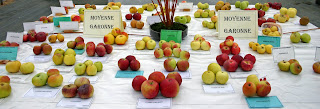
So what do a third-century virgin martyr and 2,000 heritage fruit trees have in common? The answer is a 25-acre site nestled in the rich alluvial valley of the Garonne River at Montesquieu in the Lot-et-Garonne department of Southwest France. Here, I was lucky enough to meet and talk to the passionate power behind this far reaching program to “research, protect and honor” the fruitful heritage of native species of Southwest France. And we are invited for a sneak preview by Evelyne Leterme, director and passionate founder of the CVRA- Conservatoire Vegetal Regional d’Aquitaine .


So take a mini-French vacation this weekend with me in Gascony and discover the French passion for a bite of old fashioned fruit. This year, on Ste. Catherine’s feast day weekend, November 24 & 25, the Regional Plant Conservatory of Aquitaine, locally called Le Verger-Museé , is hosting their annual Fete des Arbres.

Not long ago Mme. Leterme walked me around her fruit fief on an oriental carpet of leaf and fruit. Apples weighed heavily on sculptured boughs; semi-dwarf trees looked like some mad bonsai artist had been let loose in the orchard. There was a lone late peach variety that yield an neon peach globe, a Pêche Dur, that had great texture, like a mango and tasted of fall rather than summer- rounder, less acidic, honey juiced and …ultra-peachy. Several dozen fig varieties invited plucking; the most humble deep purple pouch, a Ronde de Bordeaux- not even as big as an egg, popped into my mouth and exploded with sweet nectar and crackling seeds. At Evelyne’s invitation, I filled my pockets with white-dotted Court Pendu Rouge de Lot-et-Garonne, a true native variety and one of the first trees I planted in my own orchard for the French Kitchen.


In the blossom spring and fruitful summer months the Orchard Museum is a delight to visit to discover the old and more aesthetic methods of planting trees and vines together. Alternating rows of trees with crops like wheat or corn are called joalle; hedgerows of hazelnuts, plums, and figs create an enclos, or enclosure, around a small pasture; strips of land are planted with riotous pink cosmos and orange zinnias to let the soil rest and feed the hardworking bee and butterfly population.


Mme. Leterme tells me how she came here from the Ecomusée de la Lande having collected samplings of fruit trees as she bicycled through the Basque country protecting both genetic history and the stories of those who labored the earth. In 1996, when she arrived in the Lot-et-Garonne, it was to establish what would become the most important collection of apple trees in France. She would begin to catalogue, protect and develop more than 800 ! varieties of apples and over 1000 other varieties of sixteen other species here in quiet Montesquieu.

Mme. Leterme’s quiet passion is catching. I found myself getting excited about the 22 different hazelnut varieties, a singular collection that she saved from destruction in Bordeaux. My own 24 tree orchard started to grow like a benevolent monster in my head as I imagined the tartes au pommes fines that I would make with a Pomme d’Anis Rosalie, an anise-scented apple or the striped Rose de Virginia or summer apple. What had once been an overgrown commercial apple orchard at Camont could live again in a tribute to the tastes and flavors from another time, when an apple or a peach, burst with its own identity of place and name.


Overwhelmed with choice, what would I chose for my birthday present? Symbolic and delicious, yet beautiful and productive? Et voila! As we reached the back of the 25 acre site, I spotted the perfect gift tree, bearing leathery orbs to sport like Christmas ornaments in the orchard.


And hidden within? Enough jewels to tempt a pirate queen. Arrrr mateys, there’s treasure within!

Apples and Saints are in the air in New York too; just ask Harold McGee at the NYTimes. Stay tuned to see what happens to this tranquil setting with 5000 hungry Frenchmen arrive. Oh, there'll be a recipe or two of course!

*"the Long Village"...what I call the 500 miles of canals and river that thread across France!

November 22, 2007

Thanks & Giving


Thanksgiving and family go together like...turkey and stuffing, sweet potatoes and bourbon, pumpkins and pies. Every year I try to arrange my states' side visit to hit this holiday above all others. No such luck this year; new dog, works in progress and a fall visit from family who came here.

Instead I'll gather with a group of expats and locals at someone's house tonight and we'll bemoan the lack of a whole turkey, and all the trimmings. There'll be no 'game' on the TV and no common traditions to share. But there will be Thanks and there will be Friendship and there will be my family held close in my thoughts as I wonder how large a turkey my brother managed to buy this year.

Oh,... and thanks to all you Turkey-eating blog readers for wondering enough about what living in France for 20 years does to you and reading my French Kitchen Adventures. Families are measured in many different ways.

November 19, 2007

Me, me, me, me, too.


The Julia Hoyt lit like a Chinese lantern.


Four by Four- a magic set of numbers. When Rosa tagged me this week in such good company, I mused over what would be my own questions.

  • Who am I?
  • Where did I come from?
  • What am I doing here in southwest France?

Boring and predictable. Then I had yet another opportunity, more common than not these days, to make e-small talk this time via the famous craigslist.org. I’m looking for a stagiare or two, to help me carry my French Kitchen Adventures into the future. Where better than to check out the local talent than nearby Toulouse? I realized as I wrote my listing there were many questions to ask…

What four things do you love most about living at the Relais de Camont?

  • The absolute stillness and quiet of this little world.
  • My gregarious French Kitchen that can hold a squished crowd of 15 people if needed but just as easily seems built for two.
  • The always running springs feeding the frog pond and lavoir hidden in the secret garden wood behind the ruin.
  • Hammocks, lots of hammocks for nap attacks.

Relais de Camont's room with a view.

What four most memorable jobs you have had?

  • Carhop in the rainy cold Seattle winter. (1 cold and wet month in 1969)
  • Puppeteer and roadie for a children’s theatre (1970-76)
  • Yacht cook and first mate (1980-82)
  • Barge captain (1987-present)

What’s the 4 best things about living on a boat?

  • Paradoxically, the stillness. This 65 ton steel hulled tank of a barge barely moves when we are moored on the quiet canal at the bottom of the garden gate.
  • The sounds: of rain on the metal deck, splashes of water against the hull in a storm, the drum vibration of the pumps, whirs and toilets flushing…
  • The light: of water reflected on the wooden ceiling, moonbeams through the portholes, the sunny wheelhouse like a greenhouse…on a chilly winter morning.
  • The wonderful sense of playing hooky all the time. It’s hard to take one self seriously when you see a flotilla of poplar leaves gliding by. I love the pick up and move along sense that you can leave at any time…

my floating office... unusually tidy!

The worst?

  • The aforementioned pumps, which you rely on them for everything- showers, drinking water, toilets…oh, the toilets! (see my blog breaking Toilet Meltdown).
  • Little spots of rust appearing under your nice new paint job. Back to the sandpaper.
  • Finding a good mechanic that won’t mess up the sweet old 120 HP DAF diesel engine.
  • The wonderful sense of playing hooky all the time. It’s hard to take one self seriously when you see a flotilla of poplar leaves gliding by….

And of course, the food questions….

What are your four favorite foods?

  • Calamari
  • Fava beans
  • Soft silky tofu
  • Ricotta cheese

Four recipes you cook all the time?

  • Soup…all kinds, mostly vegetable based.
  • Magret de Canard with a sauce aux vins
  • Clafoutis aux Pruneaux
  • Tartes- savory, sweet, fruit, etc… I love making pie crusts.

Et voila! that wasn’t so hard. So I pass this tag on to a few more e-neighbors and friends: Sweet Lucy of Lyon, Jen de Chez Loulou, Wine making Amy de la Gard in and Betty in the Aveyron.

winter knots... so easily cast off.

P.S. If anyone wants to come and work as an off-season stagiare at Camont for a few weeks over the winter: outside work, inside work, cleaning, cooking, gardening, thinking… just drop me a note with the four things that you want to learn having a French Kitchen Adventure with me in Gascony. Room and board…and a memorable job for your future list.

November 16, 2007

Swiss Chard Fritters from Laguiole


When last we met, I was telling you a little story about the road trip to Michel and Sebastian Bras joint. I got waylaid at the minuscule Saturday Morning market at Laguiole. I promised a little recipe for these savory Aveyronnais 'swiss chard' fritters called farcoux or farçous. After referencing a few old books, the fab internet and my own ideas, I plotted out a simple rule of thumb by asking a simple question:
  • How many people eating? how many things?
Since I'm on my own this week and know my own capacity for hot fried savory things is quite expansive, I opted for the 'one person/one egg 'rule of thumb. It's the same one I use for making pasta, crepes, clafoutis, creme Catalan and other egg based recipes.

Next I realized there was no milk in the house or boat. So I substituted fromage blanc. This is what happened:


one egg-
1/2 cup greens from Swiss chard- finely chopped
1 tablespoon parsley- finely chopped
1 slice onion- finely chopped
one tablespoon fromage blanc
one tablespoon flour
salt
lots of pepper


Mix all of the above in a little bowl with a fork.
Heat some oil in a pan until very hot.
Drop the farcoux in the pan by tablespoon.
Cook until golden then turn.
When cooked remove to paper to drain; dust liberally with salt and pepper.
Eat while hot. Take the dog for a walk.
See, French food is easy!


Sometimes it just as simple to make something for one as it is for a group.
With one egg and a tablespoon of milk, flour, sugar, you can spoil yourself silly.
Et voila!

November 13, 2007

what's going around... fried food.

LAGUIOLE

VERY NEW


Wonderfully Old


'The new moon cradled in the arms of the old'. That's what I say when that very New contemporary France nestles in the very old ways of la France Profonde.

"Great minds think alike... "
- that's what I say when someone scoops me on a good recipe or a new "in" place to visit.

"If you can't beat 'em...join 'em"
- if everyone else is talking about socca (not soccer!), or caramels and you have something new to add, then why not?

"What goes around...comes around"-
usually said in a disparaging tone of voice when someone has made a false move and will regret the ensuing repercussions.

Not this time! I am jumping on the bandwagon, getting on board and hoping that I can add fuel to the fire of a New old trend. Two words my friends. Fried. Food.

Maybe it started with that Dim Sum Sunday. I must confess, the steamed buns, and dumplings a la vapeur were still around for leftovers yesterday; the fried nems, beignets de choufleur and crispy samosas disappeared too fast! So when friend food writer Ed Schneider sent me a link to an article by Mark Bittman about Fried Pizza, the fried food juices started flowing. And I thought of you.

At the end of October I made a road trip up a little river (Lot) and into the Aveyron for a 3-star pilgrimage to meet and eat the Michel Bras legacy. Staying the extra day to interview the Messieurs Bras (clearly, son Sebastian is the Dauphin here-- hurray for the French sense of continuity!) was a bonus and as luck would have it was Saturday- Laguiole's market day. I love markets.
Everyone that we asked in town had told us the market was at the le parking next to the big Aubrac bull sculpture, an homage to the local breed of all things tasty- cheese, aligot, beurre. "Just look for the bull." And each person added, "mais ce n'est pas comme avant..." meaning that nothing is as it used to be.

I guess they were right. With just 4 simple stalls, this tiny off-season market pales to the number of knife shops in town (at least 2 dozen!) with one very important exception. Here, at this tiny market in the middle of nowhere was someone... cooking. Here, someone was selling something hot and... fried! Here, Mme. Sylvie was offering to cook something just for me (if the market was miniscule, so were the clients!)-- the traditional farcoux- swiss chard and parsley fritters.


For those of you whining about the dwindling dollar power...there are plenty of good things in France for just ONE EURO including these delicious homemade farcoux. Crispy on the outside, soft in the inside, hot, green and oniony, these fat beignets du blettes were just the thing needed to stave off hunger pangs before meeting the ever-so-charming and generous Michel and Sebastian Bras. (more on that... later.)


I found a recipe en francais on the very complete www.marmiton.org site; and tomorrow I'll pop into my own local market and get some chard and parsley to translate the recipe... anon. Now, if I could just duplicate the taste of the hot green fritter in my galley. Anyone else for fried food? 'I'd do offer' a better way to eat your vegetables!


View of Laguiole, the old moon, framed for you by
the very new moon M.Bras.

November 11, 2007

Eating to my Heart's Content- Gascon style


As I mentioned in an earlier post , my good friend Elaine Tin Nyo is holding down the Gascon/Burmese connection in NYC today, with a little help from her friends at AiG. So to keep them company on this side of the pond, I did a little dim sum research myself... in Agen in southwest France.


On a Sunday morning in France not much is open except for food resources, of course, and the maison de presse. So I got off the ranch early and took a little drive into downtown Agen (a mere 15 minutes away) to buy a few magazines and scout for any suitable 'dim some' sort of thing. Quelle surprise!

The 'restauration rapide' (fast food to you!) place under the medieval arches was closed although I notice they have folded Indian food under the all inclusive "Vietnamese" banner. but I was in luck as three Vietnamese/Chinese joints were not only up and running but good! I will never make fun of the too close to the train station one-restaurant Chinatown again.


I started at the meager stall in the Agen covered marche' (where poulet roti and charcuterie were running out the door); I scored the best accras de morue- not greasy and slightly piquante, the one last remaining steam bun, and a few vegetarian samosas.


Then on to park by the Cathedral St. Caprais, where I noticed that the once Breton Creperie was now La Chinoiserie. So I stopped in and order a few things to go (10% off to go!)- a steamed dumpling assortment, another steamed bun (yummy favorite of mine) and some hot Pho for a cool Gascon day. But my real destination was China Town.


Yup, just up from the Eiffel-designed train station (Paris-Agen 4- 1/4 hours by TGV), this corner shop with the only Neon in town except for the green cross pharmacy signs is our china town. It has never beckoned me in with its buffet volonte sign but now I am hooked. Although I ordered to go (after all that was Elaine's eat-in idea!) it was clearly the better deal in the French menu way for just 10 euros and 50 centimes; all you wanted from the piping hot buffet of the delicate eggplant and cauliflower beignets, crispy samosas, crab rolls, duck served many ways (it is after all still Gascony.) and tempting sweets' bar with some coconut dumpling things that I love! Not the wonderful selection of exotica found in on ealine's blog, but a welcome change for a Cassoulet overdose.


(Full disclosure- I don't know any of the real names and I just pointed to the French names and guessed and got lucky!)

And then the best for last... a beautiful plate of French dim sum desserts from the Blvd. Carnot Patisserie next door.


A truly French way to wrap up a Sunday Dim Sum on the Julia Hoyt.


Thanks Elaine! One of the few times when I can say... wish I was there.

November 10, 2007

camp cassoulet wannabees...

photo by David Lebovitz

Interested in attending you own Camp Cassoulet?
I have posted all the details and info on my French Kitchen Adventures site- www.frenchkitchenadventures.com.

How about a Christmas Cassoulet?

i

November 08, 2007

Yum Dim Sum

The best things in life are... friends.

Cassoulet making friends; market going friends; garden helping friends.
But the Best Friend of all is one that makes you hungry. The Worst Friend is one that gives you the jones for something not close at hand.

When last seen, E.T.N. (below with salty porchetta sam'iches in Chianti) and I were cruising for clandestino calamari on the Adriatico. Now she is performing this Sunday in NYC at Art in General.


For more mouthwatering information about this Dim Sum Eat In... check out Elaine's hunger producing blog at http://the-eat-in.blogspot.com/ .

Closest I can get here is take-out spring rolls from the local China Express in Agen.

November 07, 2007

Camp Cassoulet- post script point


Time to plant a few seeds for next year.
I stopped at the grainèterie yesterday on the way home from Bacon's birthday checkup- 46 kilos and still growing.
I bought 200 grams of petit pois and fava beans to plant in the potager now;
3 dozen crocus bulbs for the 'champs elysees' between the Relais and the Barge;
a few dozen Japanese iris to fill in the T-Jardin.

Then I spotted this one, singular goofy colored package of...you guessed it-
Haricots Tarbais.
These are the real deal straight from the Label Rouge approved Bean Co-op in Tarbes;
The variety Alaric and includes a few recipes inside as well. But not one for cassoulet.
They'll be saved until the early summer; I plant them in June, to be ready in October.
Just right for the 2008 Camp Cassoulet.

Now I am planning like crazy, a few more weekend cooking workshops- single subjects, finely focused, on site and lots of fun. Foie gras, confit, truffles, tourtiere pastries (heads up David and Lucy!), and the even more important whole hog, nose-to-tail charcuterie weekend. Check the calender for dates. All other ideas welcome.

And for the in between quiet times when Bacon and I just need a focus... this will do.


After all, what's the point, if not infinity?

November 06, 2007

Camp Cassoulet- the recipe en fin!


I never went to camp. So now and again that childhood desire arises and I create the ephemeral camp of my dreams. My ideas of it are all screwed up with Disney movies and girl scout meetings. But I’ve lived in a pup tent, can easily start a fire and make a mean s’more- (cultural translation here ) Or cassoulet.

For years, I have been referring to My Camont as Camp France, a sort of license to have fun in a somewhat unrealistic setting (silly big barge, small rowboat, princess tower house, big kitchen… in France.) As the cooking classes and gastronomic tours became the ‘day job’, Camp France needed to get a breath of fresh November air and breathe it did indeed this weekend!

Camp Cassoulet. 5 Americans, 3 British, 7 French, a pretty balanced group of cooks and not, convened over the Toussaint Nov 1st holiday here in Southwest France to put pay to all those Cassoulet making myths and most importantly, produce a serviceable boot-camp version of a ‘French Basix’ Cassoulet. for pictures see: http://www.flickr.com/groups/campcassoulet/

With a little encouragement from afar and a handful of French regional cookbooks, I set the standard under some protest from a few more vocal members of the gathering: no tomato, no breadcrumbs and no lamb (there’s nary a sheep in sight in this particular part of France.). As Kitchen Captain, I poo-poo-ed the holy trinity competition of city driven cassoulet (Castelnaudary, Toulouse and Carcassonne) in favor of a beginning place to understand that cassoulet is really… about the bean.

The resulting flavors were all I had hoped for- creamy, deep, crusty and soul satisfying. Hearty, yes, but also delicate in texture with sweet beanness and bursting with small morsels of savory salty and cured meats.

We began with three different beans- tarbais-the favorite, Roi du Macy that we found by chance at the Nerac market and similar to a Great Northern or Navy bean, and some dried Fava beans which I realized much too late came from Bolivia (oh, the carbon footprint of this peasant dish!); three different cassoulets cooked in three different ways: in the electric oven, in the kitchen fireplace against the coals, and in the small wood burning terracotta oven outside…oh, yeah and one on top of the stove- more on that later.

With 10 cooks, several bottles of wine and a dozen different pots to choose from …let’s just say it was fun, if a little chaotic. Personally, I like a little chaos in the kitchen so I felt right in my own home. With the help of a good crew of galley ghillies and able scribe Nicky noting it down, we did manage to weigh, measure, and time the official Camp Cassoulet cassoulet. Please feel free to take liberties as you must but this version should result in a very delicious, nicely crusted, deep-colored, traditional cassoulet. We ate it with a shallot vinaigrette winter salad of Batavia or escarole, a perfect bitter counterpoint to the simple sweet and salty cassoulet. For dessert David made a juicy Comice pear sorbet, splashed with a bit of Cote de Gascogne white wine served with chocolate, of course, biscotti and champagne. It was enough. Enough for a very memorable meal for 13 lucky friends in the French Kitchen of Camont.

Cassoulet Recipe

from Kate Hill’s French Kitchen Adventures- "Camp Cassoulet"

Amount: This makes a large cassoulet that fills a 4-liter cassole and feeds 8 people easily. For a visual reference for cassole look here, here, and here. And the Diva in Tuscany just sent this over in a little Tuscan homage to Cassoulet.

Step 1: the beans

Ingredients:

  • beans -1 kg dried beans (tarbais, coco, lingots, or other plump thin skinned white bean (for dried beans- soak over night or cover with water, bring to boil and let sit one hour.)
  • 1 onion- peeled
  • 2 cloves
  • 2 garlic cloves
  • Thick slice of ventrèche (pancetta), salt pork, bacon or ham ends.
  • Ham bone or hock
  • Fresh pork rind- about a 4 by 12 inch strip or about 100gr, rolled and tied with a string
  • Bouquet garni- bay, thyme and parsley stems.

Place all of the above ingredients in a large pot, cover with 2 litres of water; because of the addition of the ham bone there is no need to season with salt at this stage. The seasoning can be adjusted when the cassoulet is put together.
Bring the bouillon to a boil then turn down to simmer and let cook gently for 1 hour or until beans are just barely tender. How do you tell if the beans are done? The skins go papery and begin to collapse and the cooking liquid is milky.

Step 2: the meat- prepare while the beans are cooking.

Ingredients: This is where you can be flexible using fresh sausage, preserved duck or goose, ham or cured pork, lamb shanks, etc. We used:

  • Duck- confit de canard- one/half leg per person (note: after slipping off most of the softened congealed fat from the surface of the duck legs, we trimmed any excess skin so as to leave just a covering to protect the meat. We jointed the thigh from the drumstick and then teased the thigh bone out resulting in a neat little package of confit meat that is easier to cut in the plate.)
  • Saucisse de Toulouse- about 500 grams or about 15 cm/6 inches per person. This is a fresh pork sausage made from primarily the shoulder meat and seasoned with salt and pepper. Nothing else.
  • Saucisse de Couenne- I love how these succulent sausages made with lean pork meat and the soft rind taste. They sort of explode with flavour in the cassoulet.
Brown all of the above; the duck confit in a sauté pan and the sausages we cooked over the grill, however, they could have been pan browned as well. You want a nice hot fire to brown the skins and it’s preferable to not cook the sausages 100% at this stage as they will continue to cook in the cassoulet and give their juices to the broth. Note: Because we buy the sausage in one long link we made a pretty spiral that may be browned as a whole on one side then turned over in one piece to cook the other side. We did this on a grill over the hot ashes of the log fire.

Step 3: to assemble the cassoulet

The very bottom of the cassole or casserole should be lined with the cooked couenne (pork rind), fat side down. The traditional cassole bottom is just half of the diameter as the top, making a deep slant-sided glazed terracotta pot (see pictures). Remove the bouquet garni, ham bones and onion from the beans and reserve the liquid. The cassole is then layered with the beans, confits and pieces of toulouse sausage then finished with a layer of beans. In one dish, we placed a whole, unbroken spiral of sausage as the top layer. Adjust the seasoning of the broth from the beans; a little salt, black pepper and pinch of piment d’esplette tweaked the bouillon that was wonderfully savoury from the ham bones. Now add this liquid to the cassoles until the beans are just covered. Any remaining bouillon should be saved for basting if needed.

Step 4- To cook the cassoulet

Slip the cassole into a very hot oven (around 450’ F/ 275’C); turn down the oven after 30 minutes to medium heat- 350' F/175'C and let the cassoulet bake slowly. The wood oven did this by itself as the coals cooled down ; the fireplace cassoulet was covered with aluminium foil bubbled and cooked at one side at a time so we turned it every time we could hear it cooking away! This was the one that had the sausage spiral on top. The cassoulet in the electric oven was nicely browned in about 1-1/2 hours; we ‘broke’ the crust by pushing into down into the juices two or three more times. A wonderful crust forms during cooking so there is no need for a sprinkle of breadcrumbs* as the beans and sauce do this by themselves. None of the cassoulets were fatty and the one made with tarbais beans had the best texture; the beans were large, firm and creamy and there was ample 'sauce' to make the dish a little looser than the others. All cassoulets were nicely done in about 2 hours. We started preparing the cassoulet at around 3 pm and we’re sitting at the table by eight pm. This could be done in advance- all or in part by cooking the beans, and or assembling before baking.

Step 5: to serve

Pour a glass of hearty red wine like a Madiran, Cahors or Zinfandel, break the crust on top, ladle the steaming cassoulet into dishes and prepare to be very full and very warm as stories are told around the kitchen table well into the night!

cassoulet photos by: Jennifer Greco

* breadcrumbs- we nearly came to blows over this one. Although I do love a thick crumbling gratinée, I would reserve the use of breadcrumbs for non-starchy dishes and let the beans do the work here.


And for more information about organizing a Camp Cassoulet for your own groups of crazy friends contact Kate at...http://www.frenchkitchenadventures.com/

November 05, 2007

More Camp Cassoulet- the shopping list


While everyone figures out where to post the pictures, and the clever writing muse inspires, let me just tell you what we did buy on Saturday after the market...

Imagine 10 hungry foodies shopping all at once, without a list and in a hurry to go to the flea market. Shopping is always the better part of cooking here in this Southwestern Food Paradise. The country village markets are super lively on the holiday weekends like Toussaint. Families returning home for the weekend and school holidays with Grandpere and Mamie. Even our own resident Parisians found shopping a wee bit different here in Gascony as they raced through the produce, cheese and farm charcuterie stalls as Kakou, Francoise, Patricia, Marc and friends slowed them down by feeding tidbits- everything from rillettes on pain d'epice to fat mi-cuit Pruneaux (cooked/dehydrated for 12 hours instead of the usual 24). The great chunk of local Tomme de Templiers appeared from LouLou/Jennifer 's basket. Lucy de Lyon scored some of Pim's favorite grattons while Nice Tricia reserved the Marennes oysters for us and Stuart and Nicky stocked the onion/garlic larder.

By now the market baskets were bulging with:
  • a dozen huge confit de canard- duck legs
  • 2 meters of Saucisse de Toulouse
  • ventreche (salt cured rolled pork belly or bacon)
  • couenne (fresh pork rind)
  • rind and pork sausage
  • hambones
  • roi de macy beans (I already had soaked some tarbais last night)
Everyone bought something for lunch...it looked like this:
  • chestnuts
  • smoked garlic
  • onions, shallots and more garlic
  • cheese- Salers
  • grattons
  • ham
  • pate
  • rillettes
  • pate de langue
  • lettuce
  • roi de macy beans
  • brandade de morue
  • 3 dozen oysters
  • pain d'epice
  • fouace
  • pain d'epeutre
Everything that didn't go into the cassoulet (the first part of the list) was lunch!


Sometimes even food blogging tourists eyes are bigger than their stomaches. and the abundance of great charcuterie means we had one head of lettuce to 10 different pate/terrine/rillettes! Next time I'll make sure we get at least 2 of the vegetable groups we're supposed to eat even here in Gascony. I suppose chestnuts could count as a vegetable or pears for the fab sorbet David made as our fruit ration. I do know that Pruneaux count but don't think that oysters do. It's a lopsided food pyramid here that gets balanced by an abundance of good vegetable soup and fruit desserts. Oh, and the wine. Of course, the wine.

I was getting concerned we were going to run a little late, but our timing was impeccable and we were eating great cassoulet by dinner at 8.


Next post- the recipe...

November 04, 2007

Camp Cassoulet- Chestnuts for Pim- Captain Kate


Pim, I thought of you when the very first thing we saw when arriving at the Nerac market was this seasonal stall from the Pyrenees. Chestnuts, chestnuts and ..smoked garlic?

After a quick Q&A regarding the difference between Châtaignes and Marrons (The larger rounder marrons- used for those sugary Christmasy marrons glacées have no cloisson or wall dividing the nut meat into two lobes) we bought a kilo of marrons plus a braid of the wonderful smoked garlic to use this winter in savory soups. And look! We found this for you to use to cook your Chestnuts !!!


The troops quickly spun off to the far flung corners of the market gathering foie gras terrines, duck rillettes, pate de langue, Salers cheese, as I picked up the two of the essential ingredients from my best Market friend, Kakou- who after doing his best Cro-Magnon man imitation, handed over two lovely ham bones from a Jambon de Coche from the Aveyron- his favorite haunt to seek out artisan goods.

It wasn't long (after a stop for a brocante and a petite noisette (a small coffee with a splash of milk that turns it that hazelnut color), we headed back to Camont for an impromptu retour de la marche lunch featuring the above list of charcuterie. Tables cleared, wine consumed, we were ready for cook Cassoulet. Everybody- to your stations!

November 03, 2007

Camp Cassoulet- live from Gascony- David Lebovitz


Lucy, Loic, Loulou, Tricia, David L, Romain

So….here we are in Gascony. After a 10+ hour drive (which via Michelin said shoulda been 6.5….) we woke up wa-a-a-a-ayy too early & headed to the market in Nerac. Holy duck fat! What a market.

If you’re squeamish, going to a country market isn’t always recommended. One vendor had, amongst boxes of squash, tomatoes and carrots, a flat of what looked like four dead, feathery pigeons. After he showed me how he cracked their necks, which is exactly what you want to see at 10am, I learned they were doves.


Unfortunately we’re making cassoulet today, so we passed.

We tasted a terrific pain de epices with terrine on it, that was a combination I never would have dreamed of. And I think I'm going to dream of it for a couple of nights now!

Unlike Paris, it’s perfectly acceptable to touch whatever you’re buying: pears, lettuce, onions, and parsnips. And they also give you tastes. Imagine that. We bought a terrific sheeps-milk cheese and a slab of Roquefort. But of course, my favorite was the prunes, or as they call ‘em in France: pruneaux. (‘Prunes’ are what they call fresh plums.) The pruneaux d’Agen are the best anywhere and being in the epicenter of prunedom, it wasn’t hard to lug home a few kilos of the just-dried fruits.

Heavily-weighed down, we headed back to Kate’s kitchen and by the blazing fire we ate rillettes, some sort of tongue charcuterie thingy (which is like chewing your own tongue, not my favorite flavor) and marvelous oysters opened by Loïc, Lucy’s husband.

While everyone was peeling and cooking various beans, from dried favas to fresh haricots Tarbais, I made a pear sorbet mixture by carefully peeling the very ripe Comice pears and cooking them just until tender. A bit of sugar was whizzed in, a bit of white wine made it’s way as well, and off it went to the freezer for dessert tonight: it’ll be served frozen, with a drizzle of Calvados and chocolate biscotti.

posted by David Lebovitz